3:04 AM London. Sentry fires on the Belkins partner-portal — a null-pointer on the deal-sync worker, twelve events in eight minutes, same stack trace, same customer cohort. Codex is awake. It reads the Sentry event via undefined after a property rename last week. It opens PR #4471 against main, branch codex/sentry-4471-deal-sync-null, three files touched, ninety-one lines of diff, one new test that would have caught this. Commit message ends with Fixes ENG-1842. Slack posts a one-line summary into #eng-incidents with the PR link. Then it goes back to watching the queue.
8:58 AM, my coffee is hot. I open
That’s the shift hand-off. Codex worked the night. I work the day. Same repo, same context, two contracts.
Day shift, night shift#
Stop thinking of Codex and Claude Code as competing models. They’re not. They’re shifts.
Codex is the night shift — it watches Sentry, GitHub issues, the Slack #eng-incidents channel, the cron failures, the dependency-bot pings. It runs against bugs and signals 24/7. It doesn’t get tired, it doesn’t context-switch, it doesn’t have an opinion on architecture. When something breaks at 3 AM, it picks up the trace, opens a PR, posts a summary, and goes back to watching. The work it does is the work no human should have to do — the small, the repetitive, the “could have been a regex” tier of fixes.
Claude Code is the day driver. That’s where I ship features, redesign flows, write the gnarly migration, argue with the agent about whether the abstraction earns its weight. CC is the place where I bring opinion. It’s where the swarm runs — see Chapter 6 for the four parallel-agent patterns I lean on — and it’s where headless mode runs my CI builds, see Chapter 18.
The mental model that finally clicked: a 24-hour engineering org has two shifts. Day shift makes the calls. Night shift keeps the lights on. Trying to make one agent do both is the same mistake as trying to make one human do both. They burn out, or they get sloppy at the thing they’re worst at.
What Codex is great at#
The list is narrower than the marketing makes it look, and that’s a feature, not a bug.
Codex is great at incident response from logs. Sentry event lands, Codex reads the trace, finds the file, writes a fix that’s local to the trace, opens a PR with a test. Fifteen of these last month across the Belkins stack — needs Vlad’s exact number, but it’s somewhere between 12 and 20. Most are merged with one round of comments. None of them needed a feature flag, an architecture call, or a conversation.
It’s great at regression catching. When a test starts flaking on main, Codex opens an issue, runs the test ten times, captures the variance, and either pins it (slow CI runner, retry the network call) or roots it (a real race the original test didn’t catch). The PR title is always specific — flake: deal-sync.spec.ts hits Stripe rate limit on parallel run — never generic.
It’s great at doc updates that lag the code. README out of date, CHANGELOG missing the last release, OpenAPI schema doesn’t match the route. Codex reads the diff between the doc and the code, updates the doc, opens a PR. These are the PRs you merge without reading because the diff is mechanical.
It’s great at simple fixes from logs — the dependency bumped, the env var renamed, the type narrowed. The kind of fix where the right answer is “do the obvious thing, write the test that proves it, ship it.”
What Codex is bad at#
Anything that needs a strong opinion. Codex will not push back when you ask it to add a third caching layer to a system that already has two. It will add the third layer. It will add a test for the third layer. It will not say “the right move is to delete one of the existing two.” That’s the day driver’s job.
Anything that touches more than three files. The 90% confidence drops fast as the diff widens. A four-file PR from Codex is fine. A nine-file PR is a re-architecture wearing a fix’s clothes. I close those without reading and re-open them in CC where I can argue with the agent.
Anything that needs to push back on the prompt itself. If I tell CC “add a retry loop here,” CC will sometimes say “you don’t need a retry loop, the underlying call is already idempotent and the rate limit is per-second, not per-request — what you actually need is a token bucket.” Codex will add the retry loop. Both responses are useful, but only one of them is the response you wanted on the redesign.
Anything where the fix requires reading a customer thread, a Loom, or a Notion doc. Codex can read those — the MCPs are wired — but it doesn’t ask the right questions of them. It treats them as context, not as evidence. The day driver treats them as evidence.
The third instrument — Gemini in AI Studio for the idea, not the build#
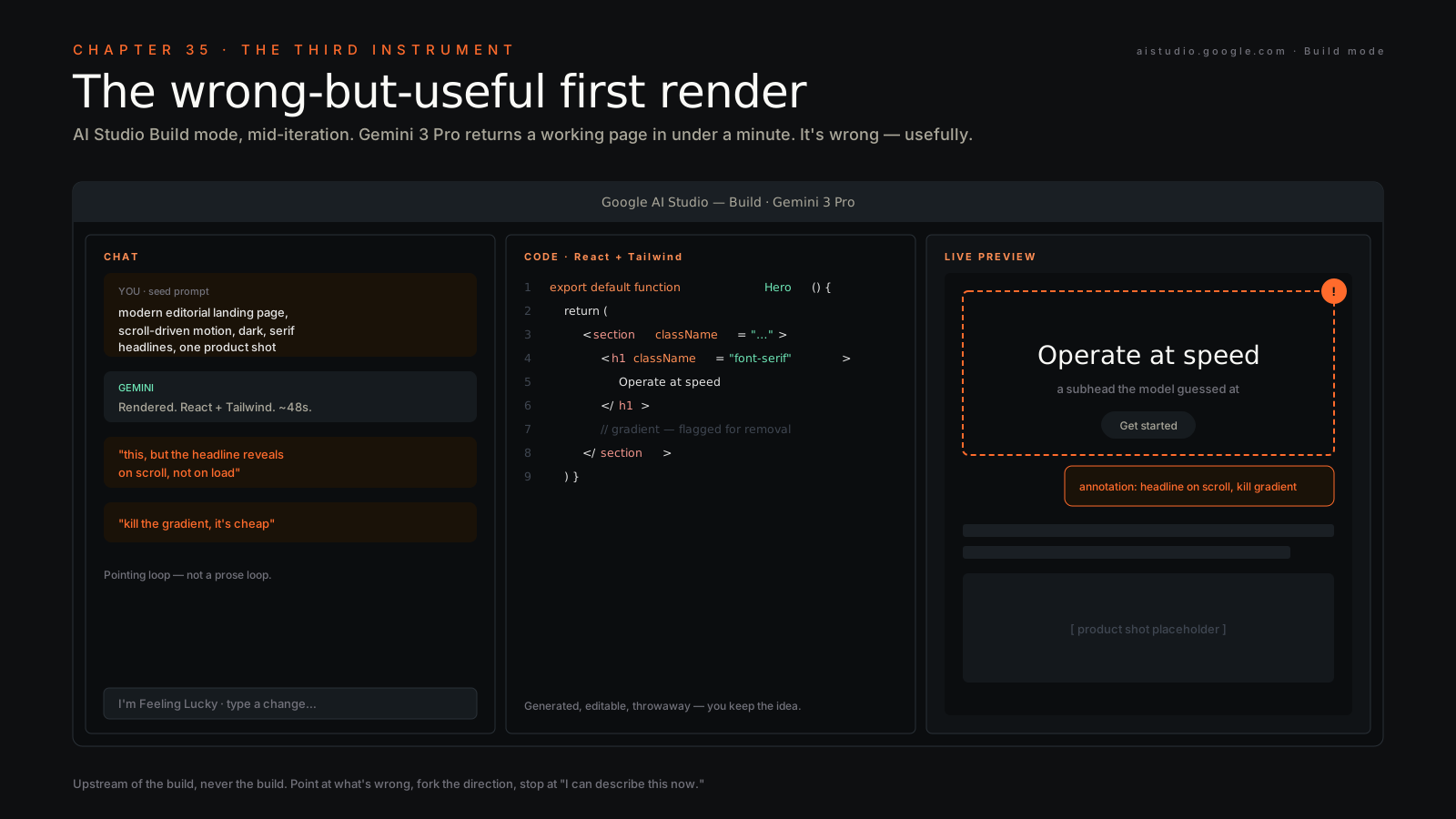
A Tuesday, 7 AM, before the portfolio wakes up. I have a vague want: a landing page for a new LinguaLive sub-brand that feels like motion without being a 2019 parallax cliché. I don’t have a design. I don’t have a brief tight enough to hand Claude. I have a feeling and a reference I can’t articulate. This is the exact state where Claude Code is the wrong tool — CC wants a spec, and I don’t have one yet. So I open aistudio.google.com, Build mode, and type one bad sentence: “modern editorial landing page, scroll-driven motion, dark, serif headlines, one product shot.” Gemini returns a working React + Tailwind page in the preview pane in under a minute. It’s wrong. It’s the useful kind of wrong — a concrete thing to react to instead of a blank canvas.
Then the loop. Not a prose loop — a pointing loop. AI Studio’s annotation mode lets me highlight the hero section directly and say “this, but the headline reveals on scroll, not on load” and “kill the gradient, it’s cheap.” Somewhere north of twenty iterations later I have three distinct directions, none of which I could have written as a prompt at 7 AM because I didn’t know they were what I wanted until I saw the wrong version first. I screenshot the one that clicks. I do not export the code. The code was never the point.
What it is. Google AI Studio (aistudio.google.com) is the free playground for Google’s flagship models — Gemini 3.1 Pro for reasoning, Gemini 3.5 Flash for speed, Nano Banana Pro for images, Veo for video. The piece that matters here is Build mode: describe an app in plain English, the Antigravity Agent generates a full React + Tailwind project, and you get a three-pane view — chat, code, live preview. You iterate by talking to it, or by annotation mode: click the rendered element and describe the change. Pointing beats describing. That’s the whole unlock. There’s also an “I’m Feeling Lucky” button that generates a starting concept when you have nothing but a cold start and need something to push against.
Why it’s a third instrument, not a third shift. Codex ships fixes. Claude Code ships features. Neither is good at the part before you know what to build — and that’s not a criticism, it’s a different job. Codex and CC are at their best with a contract: given this trace, this spec, this issue, produce this diff. AI Studio Build mode is at its best with no contract at all: given this vague feeling, produce twenty things to react to. The output of an AI Studio session is not a codebase. It’s a direction — a screenshot, a scroll behavior, a layout I can now describe to Claude Code in one tight paragraph because I’ve seen it. It deliberately does not share your repo, your .mcp.json, or your CLAUDE.md, and that’s correct. The whole value is a sandbox with no blast radius and no contract. You throw the code away. You keep the idea.
The part that earns it a slot in this chapter. Run the same one-line brief through Claude and through Gemini in AI Studio and you get two genuinely different aesthetics, because the models carry different priors from different training. Claude’s default UI sense skews one way; Gemini’s skews another. Neither is “right.” The value is the delta. When I’m stuck, the move isn’t a better prompt — it’s a second model with a different bias rendering the same brief, so I have a comparison surface instead of a single opinion to accept or reject. Two wrong answers from two different priors triangulate the right one faster than ten iterations against a single model that keeps converging on its own taste. Same argument as the design-variant swarm — but the second prior comes from a different vendor, not a different agent of the same one.
The loop that works, compressed:
- Bad one-sentence prompt into Build mode. Don’t overthink it. The first render is supposed to be wrong.
- React, don’t re-prompt. Use annotation mode — point at the thing, say what’s wrong. Pointing is faster and more honest than re-describing.
- Fork the direction, not the detail. When something clicks, push it three iterations further; when it doesn’t, abandon it — don’t repair it.
- Stop at “I can describe this now.” That’s the exit condition. The deliverable is a sharp brief, not a finished page.
- Hand the brief plus the screenshot to Claude Code. Build it for real, on a spec, in the repo.
Shared infrastructure — what they actually share#
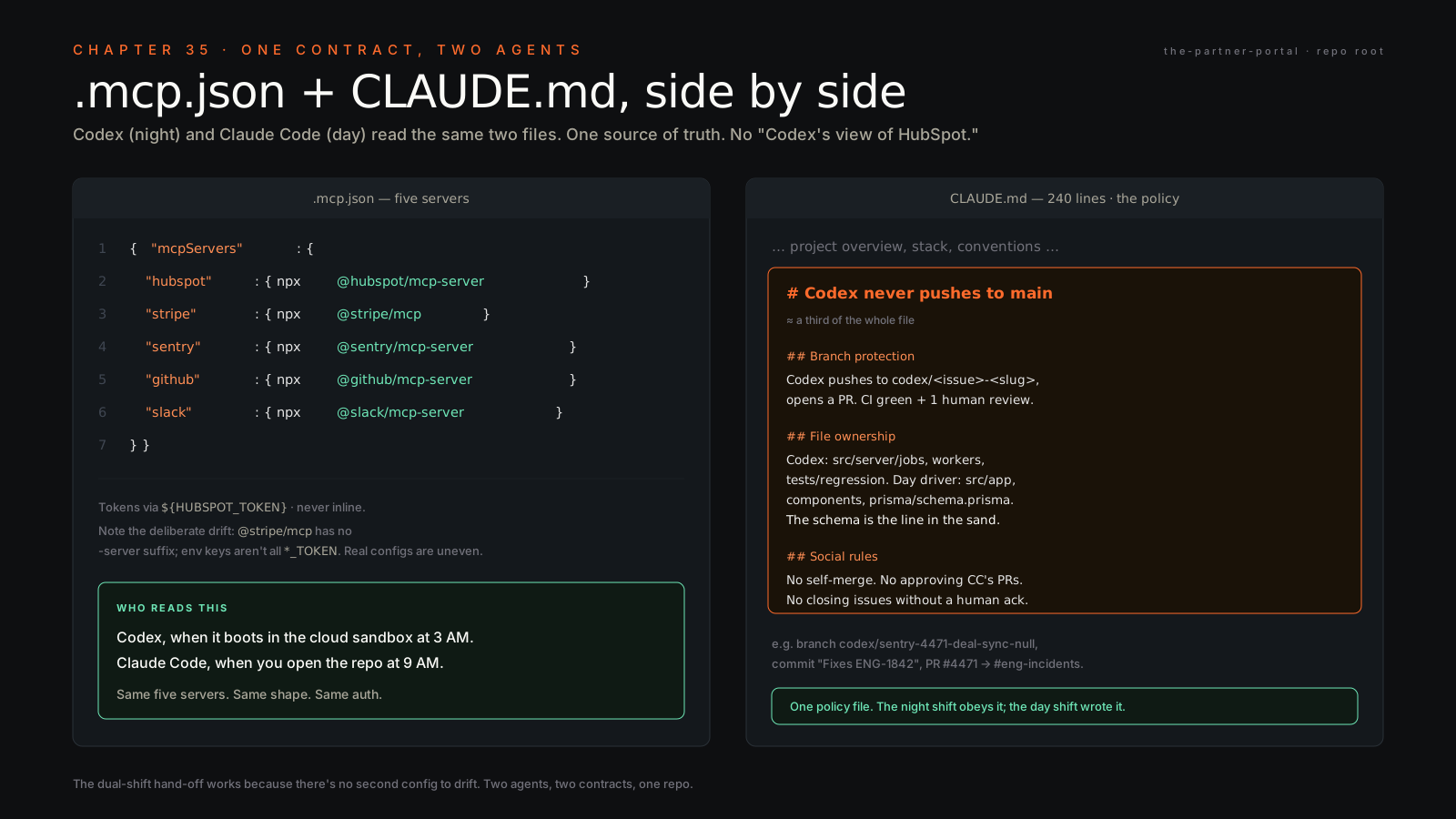
Both agents read the same .mcp.json. Both agents read the same CLAUDE.md. Both agents write to the same repo. That’s the thing that makes the shift hand-off work — there’s no second source of truth to drift, no second config to maintain, no “Codex’s view of HubSpot” vs “CC’s view of HubSpot.”
The .mcp.json at the root of the Belkins partner-portal repo:
{
  "mcpServers": {
    "hubspot": { "command": "npx", "args": ["-y", "@hubspot/mcp-server"], "env": { "HUBSPOT_TOKEN": "${HUBSPOT_TOKEN}" } },
    "stripe": { "command": "npx", "args": ["-y", "@stripe/mcp"], "env": { "STRIPE_KEY": "${STRIPE_KEY}" } },
    "sentry": { "command": "npx", "args": ["-y", "@sentry/mcp-server"], "env": { "SENTRY_AUTH": "${SENTRY_AUTH}" } },
    "github": { "command": "npx", "args": ["-y", "@github/mcp-server"], "env": { "GITHUB_TOKEN": "${GITHUB_TOKEN}" } },
    "slack": { "command": "npx", "args": ["-y", "@slack/mcp-server"], "env": { "SLACK_BOT_TOKEN": "${SLACK_BOT_TOKEN}" } }
  }
}
Five servers, one file, both agents. Codex reads it when it boots in the cloud sandbox. CC reads it when I open the repo locally. Same servers. Same shape. Same auth.
The CLAUDE.md is the contract. It’s where I tell both agents the rules of this repo — file ownership, commit message shape, test requirements, what “done” means. See Chapter 16 for how CLAUDE.md becomes the policy file that CLAUDE.md is 240 lines. About a third of it is the section called “Codex never pushes to main.”
Cost per agent per month#
The dollar figures move every quarter, so anchor on shape, not exact numbers — verify on openai.com/pricing and anthropic.com/pricing before you commit a line item.
Codex on a hosted plan, the way most teams start, runs in the low-three-figures per seat per month — call it $200 to $300 per developer for the all-you-can-eat tier as of early 2026, but verify on openai.com/pricing. Codex on a private box (a self-hosted runner with API tokens billed against your OpenAI org) is harder to forecast — the bill scales with how busy the night shift is. My Belkins partner-portal Codex spent roughly $180 in API tokens last month against the night-shift workload of about 30 PRs and 60 Sentry triages. Verify against your own usage; this is one repo, one cohort.
Claude Code is the API tokens plus the seat. The seat is in the same shape range as Codex. The tokens land where your
The honest take: if you run both, the second seat is the cheap one. The expensive one is whichever shift you ramp first, and the second is incremental — same repo, same MCPs, the marginal cost is the model bill, not the tooling.
Keeping them from stepping on each other#
Three rules, and the third one is the one that actually matters.
One: branch protection on main. Codex never pushes to main. Codex pushes to codex/<issue-id>-<slug> and opens a PR. CI must pass. One human review required. This is enforced at the GitHub branch-protection level, not the social level — the social rule will fail the first time Codex tries to “fix” a merge conflict at 4 AM.
Two: file-ownership conventions in CLAUDE.md. Codex owns src/server/jobs/, src/server/workers/, tests/regression/. Day driver owns src/app/, src/components/, prisma/schema.prisma. The schema is the line in the sand — Codex never touches the schema, because schema changes need a migration plan and a rollback story, and that’s a day-driver call. Both agents read the convention from CLAUDE.md on every session. It’s not a hope; it’s a contract the agent reads before its first tool call.
Three: the “Codex never pushes to main” rule applies socially too. Codex doesn’t merge its own PRs. Codex doesn’t approve PRs from CC sessions. Codex doesn’t close issues without a human ack. The agent has all the GitHub permissions — it could do those things — and the rule is that it doesn’t, because every shift hand-off needs a moment of human attention. That moment is the only thing standing between “the night shift caught a real bug” and “the night shift quietly merged a regression while you were asleep.”
I learned this one the hard way. Codex auto-merged a “fix” against the Folderly inbox-warmup repo last March because I’d given it merge perms during a maintenance push and forgot to revoke them. The “fix” was a one-line change that suppressed an exception. The exception was the only thing telling us a customer’s SMTP creds had rotated. Took eleven days to notice, two days to find, the customer churned. Branch protection isn’t paranoia, it’s the cheapest insurance you’ll ever buy.
The agent doesn’t get the muscle memory you get from being burned. You have to encode the muscle memory into the rules.
May 2026 update — SKILL.md goes cross-vendor#
Two things shifted under this chapter since it shipped, and both make the dual-shift setup cheaper to run, not more expensive.
The first: OpenAI Agents SDK 0.14 dropped on April 15, 2026. The headline features for this chapter are a model-native sandbox and a model-native harness — the agent loop now lives closer to the model instead of in a framework on top, which is the same direction Anthropic’s Agent SDK has been moving for a year. Subagents and code-mode are documented as “coming soon” (verify against your version/source). For the night shift, that means Codex sessions get sandbox isolation by default and the harness handles tool-call retries without me writing the loop. The 3 AM Sentry triage that opens PR #4471 in the cold open of this chapter is the kind of work that benefits most from a sandboxed runtime — it’s reading production logs and writing code; the blast radius of a bad run should be containable.
The second is the bigger shift, and it’s quiet enough that most teams haven’t noticed yet. Codex CLI now uses the same SKILL.md format as Claude Code. Same frontmatter, same trigger phrases, same directory layout. The same .claude/skills/<name>/SKILL.md file that fires a workflow in CC can fire the same workflow in Codex — no rewrite, no second skill library, no “Codex version of mentoring-lifecycle.” Skills became a cross-vendor portable artifact in May 2026, which is the biggest shift this chapter’s underlying premise has absorbed since it shipped.
The receipt I can give you from the Belkins repo: a deal-watcher skill — single SKILL.md, around 90 lines, MCP server config, three trigger phrases, one Stop hook — runs from Codex at 3 AM when a Sentry event hits the deal-sync queue, and the same skill runs from my Claude Code session at 9 AM when I’m reviewing the PR. One file, two CLIs, two shifts. The day-shift / night-shift framing in this chapter still holds. What changed is that the SKILL.md library doesn’t have to be duplicated — write skills once, use across both runtimes. See Chapter 39 for the community side of this — once the format is cross-vendor, the marketplace grows faster, and the skills you steal stop caring which agent runs them. Receipts in /research-notes.
The thing nobody talks about with dual-agent setups is that the two agents will eventually diverge in how they interpret the same CLAUDE.md. Codex reads it through the lens of “what’s the minimal compliant action,” CC reads it through the lens of “what’s the right move here.” That divergence is fine — that’s what makes them different shifts. The work is to keep the divergence productive, not to flatten it. The day shift catches what the night shift missed; the night shift catches what the day shift slept through. The repo is the thing they share. The rest is contract design.