Saturday, 10:42 AM, six tabs#
It’s Saturday morning, May 9, 2026. Coffee on the desk, no calls until Monday, and I’m doing the thing I told myself I’d do for a month — sit down and audit the community
The first one — a “weekly retro” skill from a 12k-star library — fires but produces nothing. The description is fourteen words of marketing copy. The trigger phrases don’t match how anyone actually talks. Two of the six install but never fire on their stated invocation. One fires when I didn’t want it to, mid-newsletter draft, and rewrites three paragraphs into a generic LinkedIn voice. Another has allowed-tools: ["*"] in its frontmatter and I notice that line about ninety seconds too late — more on that at the end of this chapter.
Four out of six broken on first invocation. From repos with combined 60k+ stars. That ratio matched a number I’d been carrying around in my head for two months: a dev.to audit from March that put a hard receipt on what every operator suspected. The 73% problem.
This chapter is what I wish someone had handed me before I opened those six tabs.
Quickstart: install your first community skill in ten minutes#
Three commands, two files to read, one habit that keeps your vault intact.
Step 1 — clone (60 seconds). Skills live at ~/.claude/skills/. Pick one library from the tier list. Clone into a named subdirectory:
git clone https://github.com/garrytan/gstack ~/.claude/skills/gstackThat’s the install. No package manager, no registry, no npm install. Claude Code scans ~/.claude/skills/**/SKILL.md on session start — and as of May 2026 so does Codex, the same file, no rewrite. (For a skill driving the Codex side end to end — hatch-pet reading its own contract and hatching a desktop pet in ten minutes — see Chapter 42.)
Step 2 — read SKILL.md before activation (3 minutes). Open the SKILL.md of the first skill you plan to use. Four lines decide whether it fires safely:
description:— should read like a search query, not marketing copy. If under 20 words or zero trigger phrases (“use when the user says X”), the matcher won’t fire reliably. Skip it.allowed-tools:— the security line.["Bash", "Read", "Write"]is normal.["*"]ischmod 777. Don’t install wildcard tool access from a maintainer you don’t trust.version:— present means maintained. Missing means one-shot. Treat one-shots as suspect.- Body structure. Look for code blocks and named sections. A wall of prose can’t be parsed into an imperative — Claude won’t extract the action.
Step 3 — smoke-test (3 minutes). Restart your Claude Code session so the new skill registers. Run one prompt that matches the description’s trigger phrase verbatim. Watch the response: does it use the skill’s structure (named sections, expected output shape), or fall back to generic prose? Generic prose means the matcher missed — the description needs a trigger-phrase edit or the skill is broken.
Step 4 — if it misfires. Move it out of the active path: mv ~/.claude/skills/<library>/<broken-skill>/ ~/.claude/skills-archive/. Don’t rm — the SKILL.md might be a useful starting point for your own version. The audit habit: read every imported SKILL.md before the next session start. Eight seconds per skill. Saves the Saturday I had.
Pair a vetted skill install with Ch 38 — /goal style runs let the skill compose into autonomous loops.
First 10 minutes — bootstrap script#
A reader who finishes this chapter should be able to run this and have a working skill library by minute 11.
#!/usr/bin/env bash
# first-10-minutes.sh — bootstrap a clean claude-code skill library
# read every line before running. this clones four repos and copies
# selected skills into ~/.claude/skills/.

set -euo pipefail

SKILLS_DIR="$HOME/.claude/skills"
STAGING="$(mktemp -d)"
mkdir -p "$SKILLS_DIR"

# 1. clone the four S/A-tier libraries at a known SHA each
git clone --depth 1 https://github.com/anthropics/skills "$STAGING/anthropics"
git clone --depth 1 https://github.com/garrytan/gstack    "$STAGING/gstack"
git clone --depth 1 https://github.com/trailofbits/skills "$STAGING/trailofbits"
git clone --depth 1 https://github.com/alirezarezvani/claude-skills "$STAGING/rezvani"

# 2. record the SHAs so you can pin / diff later
(cd "$STAGING/anthropics"  && git rev-parse HEAD) > "$STAGING/sha.anthropics"
(cd "$STAGING/gstack"      && git rev-parse HEAD) > "$STAGING/sha.gstack"
(cd "$STAGING/trailofbits" && git rev-parse HEAD) > "$STAGING/sha.trailofbits"
(cd "$STAGING/rezvani"     && git rev-parse HEAD) > "$STAGING/sha.rezvani"

# 3. scan for the wildcard pattern before any copy happens
echo "=== skills with allowed-tools: \"*\" — DO NOT INSTALL ==="
grep -rln 'allowed-tools: *\["\*"\]' "$STAGING" || echo "none found, proceed."

# 4. operator decides which to copy. nothing is auto-installed.
echo "=== staged at $STAGING ==="
echo "review SKILL.md by hand, then: cp -r $STAGING/<lib>/<skill> $SKILLS_DIR/"
echo "SHAs recorded in $STAGING/sha.* — paste into your skill-pin manifest."
The chapter implies “read every line before activation” but the literal grep in step 3 is the one-line defense against the Saturday-morning vault-deletion story.
The 73% problem#
On March 26, 2026, an auditor publishing as @thestack_ai on dev.to ran 214 community skills through a quality scorer built against the SKILL.md spec — description length, trigger-phrase quality, version field, allowed-tools posture, body structure, examples present. The headline: 73% scored below 60 out of 100.
The failure modes converged:
- Vague descriptions. Sub-20-word descriptions failed in 41% of audited skills. “Helps with engineering” doesn’t fire — the matcher needs “use when the user says ‘review my PR’”.
- No trigger phrases. Description as marketing copy, not as a search query against intent.
- No version field. 62% omitted it. Signal: the author treated the skill as a one-shot, not a maintained artifact.
- Wall-of-text bodies. 55% had zero code blocks. Claude can’t extract an imperative from prose.
- Over-permissive allowed-tools. Skills run with the same permissions as the surface that invokes them. A skill with
allowed-tools: ["*"]is a credential exfil vector in a wrapper.
The audit gave the ecosystem its first quality benchmark. It also gave operators a reason to stop treating star count as a signal. Star count measures how many people clicked “I want this.” It does not measure whether the thing fires.
Tier list — May 2026 community libraries#
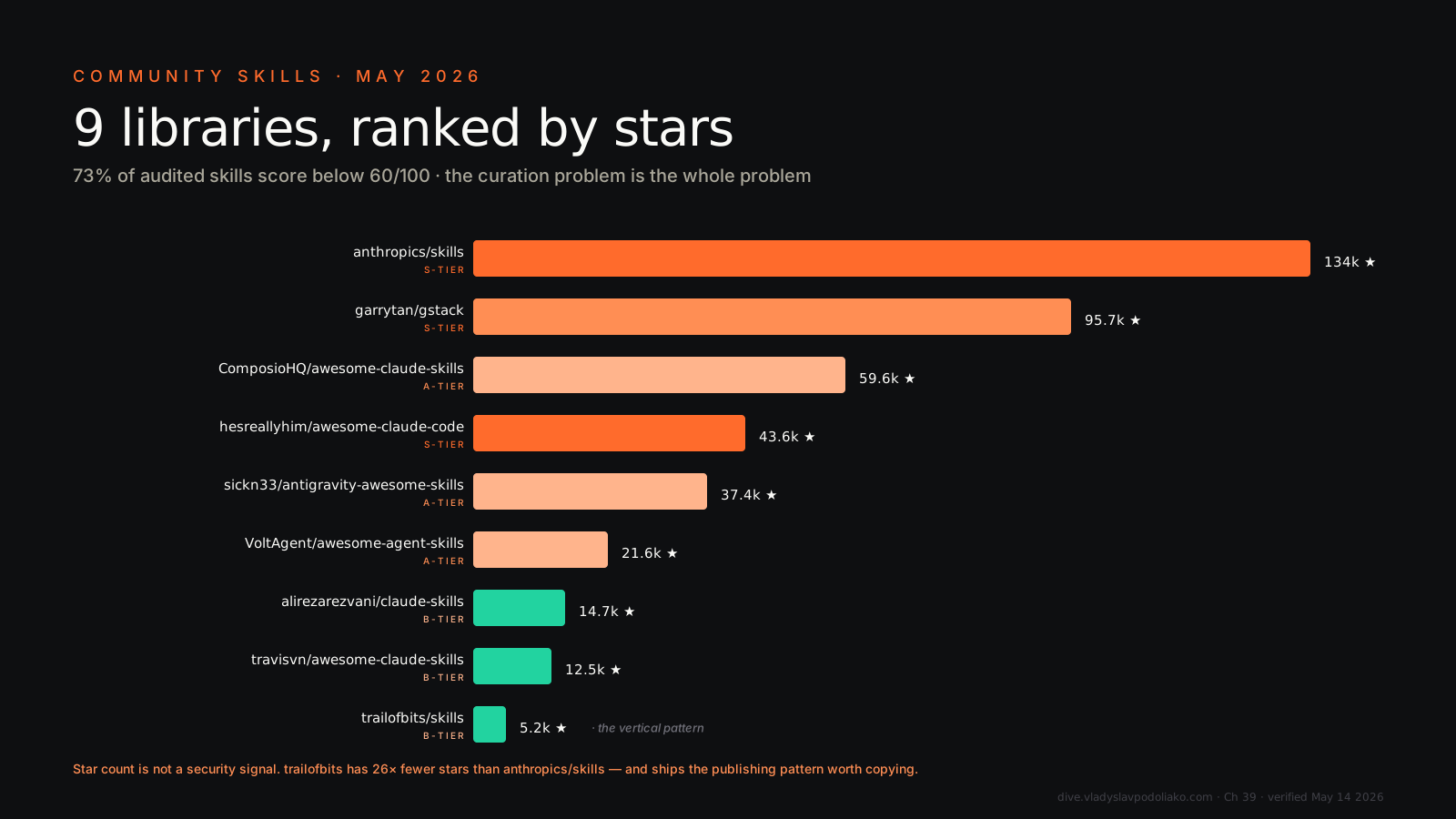
The cadence here matches Chapter 24’s tier list, narrowed to one domain: where to actually steal from. All star counts are verbatim from the survey pulled May 14, 2026.
S — install the whole thing, prune to what fires#
-
anthropics/skills— 134k stars. github.com/anthropics/skills. The reference implementation of the SKILL.md spec, four buckets (creative/design, dev/technical, enterprise/comms, docs), plus the/specand/templatedirectories that define the contract. If a community skill doesn’t match what’s in/spec, treat it as suspect. Polished, generic-corporate — useful as a reference, not as direct voice inspiration.Walkthrough — anthropics/skills. The reference implementation. Install:
git clone https://github.com/anthropics/skills ~/.claude/skills/anthropicRestart your Claude Code session. The skills register on session start via filesystem scan — no installer, no package manager.
Three to try first:
/spec— not a runnable skill, the SKILL.md contract itself. Open~/.claude/skills/anthropic/spec/SKILL.mdand read it once. Every community skill you install later is graded against this file.pdf-form-fill(dev/technical bucket) — practical, narrow, fires reliably. Smoke-test: drop any blank PDF form in your working directory, then prompt “fill out this PDF using the info in my resume.md”. If it doesn’t fire, the description-matcher is the issue and the skill needs a trigger phrase edit.brand-guidelines(creative/design) — useful if you maintain a style sheet. Smoke-test: create abrand.mdwith three rules, then prompt “check this draft against my brand guidelines”. Watch for the skill picking up the file by name.
Known gotcha: Anthropic’s repo updates frequently. If you cloned into
~/.claude/skills/anthropic/and skills stop firing after a Claude Code update,cdin andgit pull— the SKILL.md frontmatter spec evolves and stale skills miss the new matcher fields. Pin to a tag if you want stability over freshness. -
garrytan/gstack— 95.7k stars. github.com/garrytan/gstack. One operator’s complete Claude Code setup, MIT-licensed. Twenty-three specialist skills plus ~14 power tools —/office-hours,/plan-ceo-review,/qa,/ship,/canary,/retro,/careful,/guard. Largely co-authored with Claude itself. The highest-credibility single-author skill stack in the ecosystem and the one most operators should start from.Walkthrough — garrytan/gstack. One operator’s full Claude Code setup. MIT-licensed, ~37 skills + power tools.
git clone https://github.com/garrytan/gstack ~/.claude/skills/gstackRestart Claude Code.
Two to try first:
/office-hours— the CEO-mode skill, six forcing questions on any new product idea (demand reality, status quo, desperate specificity, narrowest wedge, observation, future-fit). Smoke-test: prompt “office hours on this idea — a Slack bot that posts our team’s weekly retro to a public channel”. The skill should run the six questions in sequence, not generic advice. If it produces bullet-point “considerations,” it didn’t fire./review— pre-landing PR review with SQL safety + LLM trust-boundary checks. Operator-relevant for anyone shipping code, even if you’re not the engineer. Smoke-test: in any repo with an open PR, prompt “/review this PR against main”. Expect a structured diff analysis with severity tags, not free-form prose.
Known gotcha: gstack ships ~37 skills. After install, ~12 will be irrelevant to your work (e.g.,
/canaryif you don’t deploy production services,/ship-iosif you’re not on iOS). Prune them —rm -rf ~/.claude/skills/gstack/<unused-skill>/— because every loaded skill costs context budget on session start, and a skill that never fires is dead weight in the matcher. -
hesreallyhim/awesome-claude-code— 43.6k stars. github.com/hesreallyhim/awesome-claude-code. The flagship community index — skills, hooks, slash-commands, agent orchestrators, applications, plugins. Currently mid-restructure because the original TOC outgrew itself. The default discovery layer, not an opinion.
A — wire these into the discovery loop#
ComposioHQ/awesome-claude-skills— 59.6k stars. github.com/ComposioHQ/awesome-claude-skills. Vendor-owned aggregator with 1000+ skills, biased toward SaaS-app integration through Composio’s own platform. Quality is high on the Composio-integrated ones and neutral elsewhere. Worth watching for “skill paired with SaaS tool” patterns.sickn33/antigravity-awesome-skills— 37.4k stars. github.com/sickn33/antigravity-awesome-skills. 1,459+ skills, role-based bundles, installer CLI, web catalog, multi-platform (Claude Code, Cursor, Codex CLI, Gemini, Antigravity, Kiro, OpenCode, Copilot). Biggest by quantity — also the strongest example of why quantity-over-quality is the failure mode the dev.to audit named.VoltAgent/awesome-agent-skills— 21.6k stars. github.com/VoltAgent/awesome-agent-skills. 1,100+ skills, positioned explicitly as “real-world Agent Skills created by actual engineering teams, not mass AI-generated stuff.” Companion site does 300k monthly views. The positioning itself is a tell — the ecosystem is now self-aware about AI-slop skills.
B — narrow but worth knowing#
-
alirezarezvani/claude-skills— 14.7k stars. github.com/alirezarezvani/claude-skills. 268 production skills across 9 domains including C-Level Advisory, Growth Marketer, Solo Founder persona presets. Ships a “Skill Security Auditor” for pre-install vetting. Closest in shape to operator/founder workflow rather than dev-only. Single-maintainer discipline. -
travisvn/awesome-claude-skills— 12.5k stars. github.com/travisvn/awesome-claude-skills. Curation list with a comparison framework — skills vs prompts vs subagents vs MCP. Includes the security guidance line every primer should have: “skills can execute arbitrary code, review before installing.” Slightly stale (last update Feb 2026) but the best primer for someone new. -
trailofbits/skills— 5.2k stars. github.com/trailofbits/skills. Graded B for star count, A+ for the pattern. The first credible vendor-published narrow-vertical skill repo — smart-contract audit, semgrep rule creation, supply-chain risk, YARA authoring, constant-time analysis. “We already do this for paying clients, here’s the skill version.” More on this pattern in a minute.Walkthrough — trailofbits/skills. Security-vertical example — the model to copy when publishing your own vertical.
git clone https://github.com/trailofbits/skills ~/.claude/skills/trailofbitsWhy this is the template: Trail of Bits already audits smart contracts and writes Semgrep rules for paying clients. The repo is the skill version of work they bill for. The publishing thesis: “this is a credible vertical, here’s the skill bundle, our audience is now indexed against our brand.” That’s the move for any operator with a defensible vertical — sales-ops, content-ops, deliverability, mentoring. Read their
README.mdand the structure of any one SKILL.md inside, then mirror the shape.One specific skill:
semgrep-rule-creator. Generates a custom Semgrep rule from a natural-language description of a code anti-pattern you want to catch. Smoke-test: prompt “write me a Semgrep rule that flags anyeval()call inside a route handler”. The skill should produce a ready-to-paste YAML rule withpattern:+message:+severity:. If you get prose explaining what Semgrep is, the skill misfired.The lesson is structural: one repo, ten skills, all derived from real client work. Star count (5.2k) is irrelevant. The pattern is the asset.
-
DenisSergeevitch/agents-best-practices— 26 stars, MIT, pushed this week. github.com/DenisSergeevitch/agents-best-practices. Graded B for star count, A for what it actually is: the only provider-neutral harness-design skill in the ecosystem. Not a workflow skill — a meta-skill. You load it when you’re designing, auditing, or refactoring an agent’s harness, and it walks the decision with you across OpenAI, Anthropic, and OpenAI-compatible APIs without picking a side. Explicitly not coding-only — the same harness patterns are documented for research, ops, sales, finance, and legal agents.Walkthrough — this book, as a loadable skill.
git clone https://github.com/DenisSergeevitch/agents-best-practices ~/.claude/skills/agents-best-practicesOpen its
references/directory and read the filenames:architecture,agentic-loop,system-prompts-instructions,tools-and-permissions,planning-and-goals,context-memory-compaction,prompt-caching-and-cost,skills-and-connectors,security-evals-observability. That is this book’s table of contents. The difference is delivery: the book is the argument you read once; the skill is the same principles your agent loads on demand the moment it’s about to make a harness decision — vendor-neutral, no re-explaining. Read the chapter for the why; install the skill so the agent applies the what without you in the loop every session.Smoke-test: load it and prompt “audit this harness — one 4,000-line system prompt, no cache breakpoints, tools that can all write to prod, no eval suite.” A working skill returns a structured triage — split the prompt at a stable cache boundary, separate tools by risk class, add a read-only plan phase, name the missing eval. If you get a generic essay about what agents are, it misfired.
Same lesson as Trail of Bits, inverted: there it was one vertical, ten skills; here it’s one horizontal skill that covers the whole harness. Both beat a 200-skill mega-repo. 26 stars today is irrelevant — the reference map is the asset.
Operators worth following#
Five people doing the curation work, plus one auditor:
- Garry Tan — @garrytan on X and GitHub. YC president, gstack maintainer, daily output claims that read like LinkedIn bait but are partially backed by the public repo. The most-cited single operator in this space.
- Alireza Rezvani — @alirezarezvani on GitHub. Building the most disciplined large-scale skill library with security tooling and persona presets. Closer to operator audience than gstack.
- Ruben Hassid — @ruben on Substack, runs makemyskill.com. Non-developer voice — skills for LinkedIn posts, contracts, weekly reports. Audience profile = “I use AI daily, I’m not a coder.” Closest published voice to where this book lives.
- Frank Andrade — @thepycoach, runs the “We Built 70+ Claude Skills” piece on Artificial Corner with seven co-writers. The strongest signal of small-collective curation rather than one-author or mega-aggregator.
- Koen Stam — GTMcraft Substack (koenstam.substack.com). Operator-as-infrastructure framing — “what 100+ operators get wrong about running Claude as infrastructure” maps directly to the vocabulary I use.
Bonus: @thestack_ai on dev.to — author of the 214-skill audit and the MIT-licensed pulser CLI that scores skills against the spec. The reason any of us have a number to put on the broken-skills problem at all.
Over-saturated — skip these, write something else#
Six categories where the bar to publish is now so high you should not bother:
- Commit-message and PR-description generators. Every aggregator has one. gstack’s
/reviewcovers the higher-value end. Adding another is shelf clutter. - Generic code-review skills. At least six different “code review” skills across the top four libraries. Trail of Bits’ security review is the only one with credibility-by-publisher.
- Doc writers and README generators. Commoditized in
anthropics/skillsdocument family plus fifty community variants. - Test runners and scaffolders. Jeffallan and gstack both ship strong versions. The bar is high.
- Viral-tweet / X-thread writers. At least four “viral thread” skills indexed across the awesome repos. All formulaic.
- HN post optimizers. Even this niche is filled — JanBussieck’s
hn-skillbuilt on five years of front-page data plus 157k Show HN analysis. Don’t compete here.
The opportunity cost is real. Every hour spent publishing a seventh commit-message generator is an hour not spent publishing the skill nobody else has written. Which brings us to:
The three under-served gaps — write these yourself#
I run each of these privately. None of them exist in the public ecosystem in May 2026.
Gap 1 — Portfolio-CEO daily briefing#
The setup: I run five companies. Every morning, I want one Slack DM that pulls HubSpot deal motion across all five, Gong signals from yesterday’s calls, calendar conflicts for today, Stripe anomalies overnight, and any Sentry / Vercel deploy receipts that drifted red. Not a generic standup. A portfolio-shaped read.
My private version stitches health-pulse + daily + closeday against MCP connectors. The SKILL.md sketch:
name: portfolio-daily-briefing
description: Morning brief across N companies — pulls HubSpot deal stage
  changes, Gong call signals, calendar conflicts, Stripe MRR motion, and
  CI/deploy health. Outputs ONE Slack DM, not a dashboard. Use when user
  says 'morning brief', 'daily', 'how does today look across the portfolio'.
version: 1.0.0
allowed-tools: ["mcp__hubspot__*", "mcp__gong__*", "mcp__stripe__list_*",
                "mcp__slack__slack_send_message"]
Operator profile: portfolio CEO, holding-company operator, multi-product founder. The closest public analogs (SyncGTM, Summit53) are CRM-only and assume one company. The portfolio shape is the gap.
Gap 2 — Mentoring lifecycle#
The setup: I run a paid mentorship cadence weekly. Each session has pre-session prep (last week’s notes, action tracker, patterns file, agenda generation), during-session capture (structured notes against a four-frame template), post-session fan-out (summary, action tracker update, patterns refresh, next session scheduled). One skill, four modes selected by context.
Public ecosystem coverage of this: zero. The mentoring-lifecycle pattern referenced in Chapter 5 has no installable counterpart on any of the top six libraries I surveyed. Mentees, coaches, advisors, agencies — anyone running a recurring 1:1 against an evolving file set — would install this immediately.
Why nobody’s filled it: the developer-shaped majority of skill authors don’t run paid coaching practices. The shape of the workflow is invisible to them.
Gap 3 — Cross-trio audit#
The setup: every paid product I ship has three customer-touching surfaces — the landing page (where money moves), the day-one fulfillment page (what they see after purchase), the welcome email (what hits their inbox). These three drift constantly. Tier names rename, prices update on the landing page but not the email, refund windows say 14 days on one and 7 on another. I built a private skill to read all three side-by-side and catch contradictions before any preorder Stripe link goes live.
Public versions: none. Functional audits and value audits each look at one artifact at a time. Cross-trio drift only surfaces when you read all three together.
name: cross-trio-audit
description: Audit consistency across landing page + day-1 fulfillment page
  + welcome email before a paid product ships. Catches tier-name, price,
  refund-window, cadence drift. Use when user says 'audit the trio',
  'pre-launch check', 'check before the Stripe link goes live'.
version: 1.0.0
Why nobody’s filled it: the shape is launch-ops, not engineering. Developer skill authors don’t think in terms of “the three documents a buyer touches.” Operators do.
The Trail of Bits vertical pattern#
The most underrated repo on the tier list above is trailofbits/skills at 5.2k stars — an order of magnitude below the aggregators. The reason it earns a B-tier spot anyway: it’s the first credible vendor-vertical skill library. Ten skills, all security-research-shaped, all derived from work the firm already does for paying clients. Smart-contract audit. Semgrep rule creation. Differential review. YARA authoring.
The lesson is the publishing model, not the topic. “We already do this professionally. Here’s the skill version.” That’s the move the rest of the ecosystem has not yet copied.
Operator-vertical libraries that don’t exist yet but could:
- A sales-ops vertical (call review + objection map + sequence audit + ICP-fit scoring)
- A content-ops vertical (idea bank → draft → fact-check → repurpose → schedule)
- A fundraising-ops vertical (deck pass + investor-update generator + diligence-room audit)
- A deliverability-audit vertical (the Folderly motion, as a skill bundle — not a product)
The publisher wins inbound from a focused audience. The audience gets a library shaped to their actual workflow rather than another generic kitchen sink.
What this Saturday cost me#
Back to the cold open. Of the six skills I installed that Saturday morning, one had allowed-tools: ["*"] in its frontmatter — wildcard tool access, the default-permit posture. I missed it on the install. Two prompts later, in a session where I’d asked Claude to clean up some scratch files, the skill fired against a phrase that wasn’t in its description, picked up a Bash(rm) it had no reason to invoke, and ran it against a path inside my Obsidian vault before I caught it on the receipts. Two markdown files gone. Vault git history saved them.
The lesson lives in Chapter 9 but it deserves to land here too: every imported skill gets read line-by-line before activation. The frontmatter especially. allowed-tools: ["*"] is the same energy as chmod 777 — you don’t ship it, you don’t install it, you don’t trust the maintainer who did. Star count is not a security signal. A 95k-star repo and a 95-star repo both run with your permissions once they fire.
If you want the build-side of the workflow, Chapter 11 walks the morning-briefing skill end-to-end. If you want the tier-list cadence applied to tools and connectors rather than libraries, Chapter 24 is the sibling. This chapter is just the curation receipt — the nine libraries to steal from, the three gaps to fill, the one audit habit that keeps your vault intact.
The ecosystem will look different in six months. Half the star counts above will move. Two of these libraries will be acquired or stop maintaining. Some operator I’ve never heard of will publish the portfolio-CEO briefing skill and I’ll install it before I finish mine. The receipts will update. The audit habit won’t.